
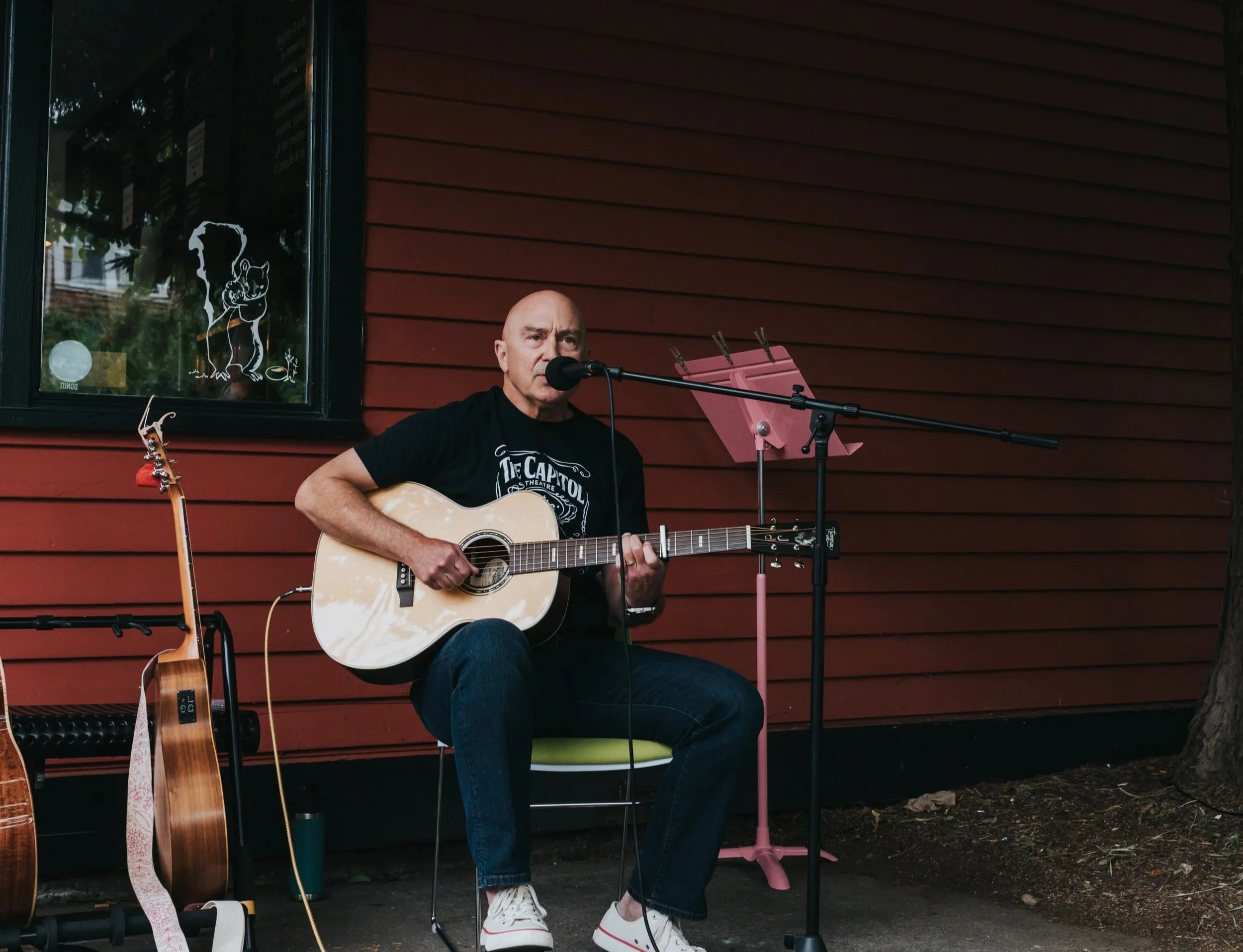
ABOUT JEFFREY PYATT
For Jeffrey Pyatt, music has always been part of the way he experiences and understands the world.
His songs draw from the sounds, places, and stories that have shaped him—from growing up in Denver and later Seattle to a wide range of influences including classic rock, soul, protest music, country, blues, reggae, and jazz. He started playing drums at age 10 before eventually picking up the guitar, and music remained a constant even as career, entrepreneurship, family, and other responsibilities took center stage.
Today, Jeffrey is giving more space to songwriting and the stories he wants to tell through music. He has released four singles, including one live recording, working with notable Nashville producers Cindy Morgan and Phil Madeira to bring his songs to life. His rootsy, folk- and country-influenced music explores social issues, humanity, memory, family, and the world around him without trying to preach or provide easy answers. For Jeffrey, this chapter is about creating with greater freedom and intention—and hoping the songs leave listeners feeling something long after the music stops.
Get to Know Jeffrey
Music has been part of Jeffrey Pyatt’s life for as long as he can remember, but songwriting came later.
From childhood memories of singing along to the radio in Denver to choir, drums, guitar, open mics, and eventually recording original songs, Jeff’s path to making music has unfolded over decades. His songs draw from that lived experience, exploring family, history, injustice, empathy, and the things that shape the way we see one another.
Here, Jeff shares more about where his love of music began, what brought him back to it, and the stories behind the songs he is writing now.
What are some of your earliest memories of music?
Some of my earliest memories are riding around Denver with my mom and sister listening to KIMN radio. We would sing along together, sometimes finding the melody and sometimes the harmony. Music was just naturally part of our family life.
I also had a classically trained music teacher when I was young and participated in choir and school operettas. By the time I was about 10, I had started playing drums, so music was always there in one form or another.
How did you eventually move from drums to guitar?
I played drums when I was younger, but when I got to college, I sold my drum kit and bought my first guitar.
The guitar stayed with me, although there were long stretches of life when music wasn’t the main focus. Just before COVID, as I started thinking more seriously about retirement and what I wanted the next chapter of my life to look like, I picked it back up with more intention.
That eventually led to songwriting, voice lessons, open mics, recording, and performing my own music.
Why did you decide to pursue music more seriously at this point in your life?
I think I reached a point where I realized there were things I had carried with me for a long time that I still wanted to say.
Coming back to music wasn’t really about trying to make up for lost time. It felt more like finally giving myself the space to see where it could go. Over the years, you collect stories, experiences, questions, and observations. Songwriting gave me a way to do something with all of that.
There is also something exciting about discovering a new creative chapter later in life. I’m still learning and still stretching myself.
Do you remember writing your first song?
Very clearly. The first song I wrote was called “Poor People Die Too.”
The idea came to me four or five years ago while my wife, Paula, and I were driving from Boise toward Sun Valley. She was asleep in the passenger seat, and I started working through the idea in my head as I drove.
That song stayed with me. Eventually, I began taking voice lessons and performing at open mics because I realized that if I was going to write these songs, I wanted to learn how to share them too.
That first song really opened the door to everything that followed.
What kinds of music have influenced you?
My influences are broad. I grew up listening to classic rock, soul, country, blues, reggae, jazz, protest music, and a lot of music from the ’50s and ’60s.
I think pieces of all of that find their way into what I write now. I’m especially drawn to songs that have something underneath them — a story, a point of view, a feeling, or a question that stays with you.
What I make now probably lands somewhere in folk, Americana, blues, and roots music, but I don’t spend too much time trying to fit it into one category.
Where do your songs usually begin?
Usually with something that won’t leave me alone.
It might be a memory, a person, something happening in the world, a piece of history, or a question I keep coming back to. Sometimes an idea stays with me for a long time before I know exactly what the song is.
I’m especially interested in the places where individual stories connect to something bigger. Family, history, injustice, hope, empathy, and the way people treat one another all show up in my writing.
Why are history and social issues such a recurring part of your songwriting?
I think music gives us a way to look at difficult subjects through people and stories rather than just arguments.
I’m interested in what history can teach us, especially when we slow down long enough to look at the people inside it. The same is true of the issues we are facing now. There are real human lives behind all of them.
I’m not interested in telling listeners exactly what they have to think. I would rather write something that makes someone feel, reflect, ask a question, or look at another person’s experience a little differently.
What has surprised you most about becoming a songwriter?
Probably how much there is still to learn.
Writing the song is only one piece of it. Learning how to sing it, perform it, record it, work with other musicians, and hear your own writing differently once other people become part of the process has been incredibly rewarding.
It has also introduced me to people I never would have met otherwise.
What was it like performing your own music for the first time?
There was definitely a learning curve.
After I started taking voice lessons, I began going to open mics and getting comfortable performing songs in front of people. My first full set was at Russell Road Revival in Santa Fe, at my daughter and son-in-law’s property.
There is something very different about playing a song you wrote yourself. You’re sharing more than music. You’re sharing an idea or part of your own perspective, and that makes the experience much more personal.
What do you hope people take away from your music?
First, I hope they connect with it.
Some songs might make you uncomfortable. Others might make you hopeful or remind you of something from your own life. I want there to be room for all of that.
More than anything, I hope the songs encourage people to pay attention — to our history, to each other, and to the world around us. If a song creates empathy, starts a conversation, or makes someone think about something differently, then it has done something meaningful.